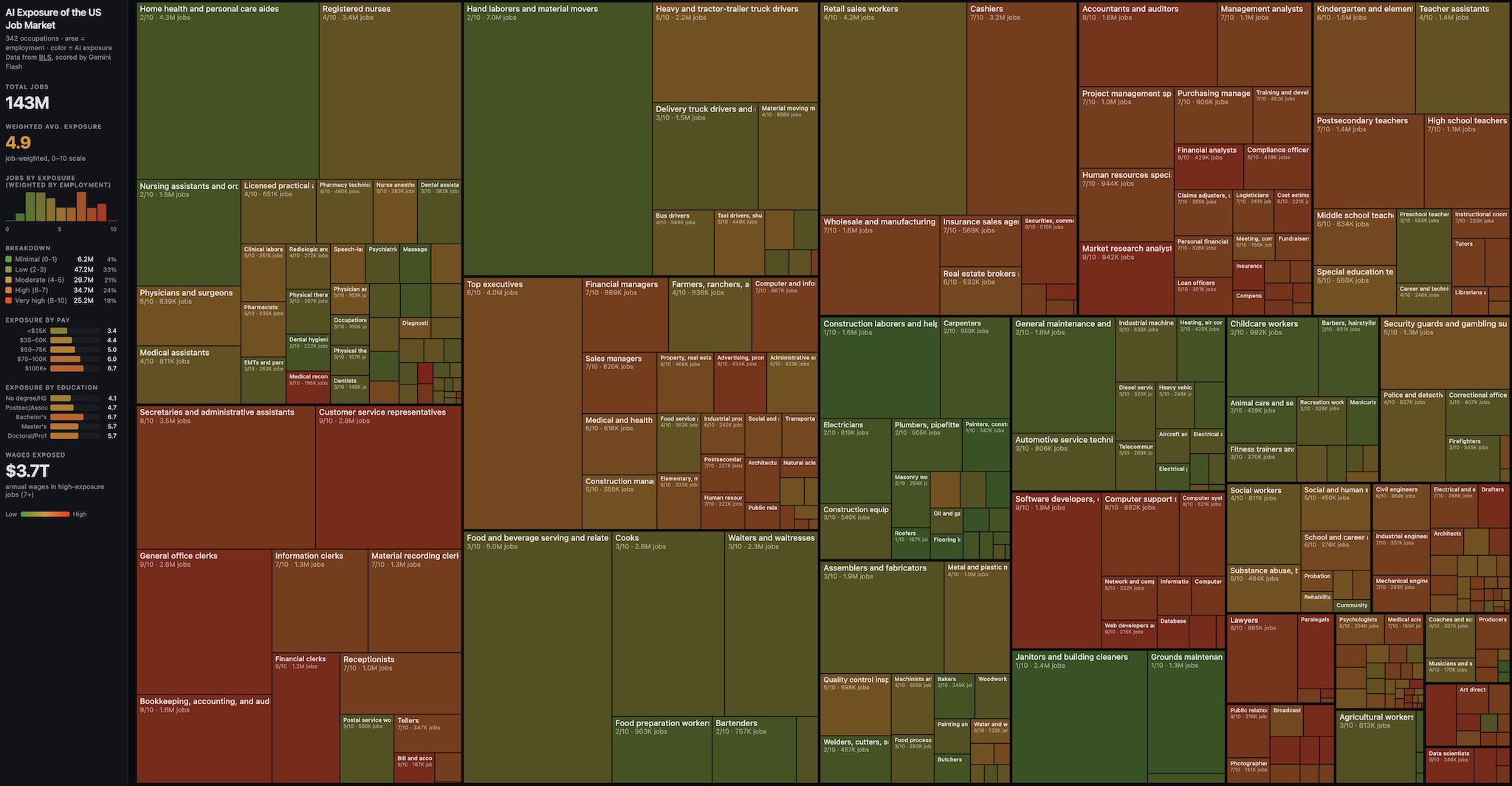
Exposure Breakdown
| Category | Jobs | % of Total |
|---|---|---|
| Minimal (0-1) | 6.2M | 4% |
| Low (2-3) | 14.1M | 10% |
| Moderate (4-5) | 29.3M | 21% |
| High (6-7) | 34.2M | 24% |
| Very High (8-10) | 35.2M | 25% |
By Education Level
| Education | Avg. AI Exposure |
|---|---|
| No degree required | 3.5 |
| High school diploma | 4.1 |
| Associate's degree | 4.7 |
| Bachelor's degree | 6.7 |
| Master's degree | 7.1 |
| Doctoral / Professional | 8.7 |
Most Exposed Professions
Secretaries & Administrative Assistants
9/10Scheduling, email, document management, data entry — AI already does all of this faster.
Customer Service Representatives
9/10Chatbots and AI agents are replacing call centers globally. This is happening NOW.
Financial Analysts
8/10Financial modeling, risk assessment, market analysis — AI processes data faster than any human team.
Accountants & Auditors
8/10Bookkeeping is already automated. Audit trails, compliance checks, tax prep — all AI territory.
Software Developers
7/10AI writes code, debugs, deploys. Junior dev roles are the first to be absorbed.
Lawyers & Legal Assistants
7/10Document review, contract analysis, legal research — AI already outperforms associates in speed.
Least Exposed Professions
Home Health & Personal Care Aides
1/10Physical presence, empathy, hands-on care. Robots can't hold someone's hand.
Construction Laborers
2/10Unpredictable environments, physical manipulation, weather — AI struggles with the real world.
Childcare Workers
2/10Trust, safety, human connection. No parent is leaving their kid with a robot.
Plumbers & Electricians
2/10Physical problem-solving in unpredictable spaces. The trades are AI-proof for now.
Key Takeaways
- 1 Higher education = higher exposure. Doctoral & professional degrees average 8.7/10 exposure. The more your job is "thinking work," the more AI can do it.
- 2 $3.7 TRILLION in wages are in the high-exposure zone. That's not a prediction — that's money that will be redirected as AI tools become standard.
- 3 Physical jobs are the safest. Healthcare aides, construction, trades, cleaning — anything requiring hands, presence, and improvisation remains human.
- 4 Office work is the most vulnerable. Admin, customer service, data entry, financial analysis — these are being replaced right now, not in 10 years.
- 5 The question isn't "will AI take my job?" — it's "am I using AI to stay ahead?" Those who learn to work WITH AI will thrive. Those who ignore it will be replaced by someone who doesn't.